
Why You Get Sick On The First Day Off
September 2026
By Shipra
You held it together for eleven straight weeks. Through the deadline, through the quarter, through whatever it was.
Then the holiday started. And by day two you were in bed with a temperature.
You’ve called that bad luck for years. Possibly you’ve made a joke of it, typical, happens every time.
It isn’t luck, and it happens often enough to have a name.
It has a name and a small body of research
In 2001, Dutch psychologists Ad Vingerhoets and Maaike van Huijgevoort presented a paper on what they called leisure sickness, the phenomenon of people who are rarely ill during the working week and get sick reliably on weekends or holidays.
The pilot study surveyed a representative Dutch sample of 1,128 men and 765 women. Around 3% recognised themselves in the description. The most commonly reported symptoms were headache and migraine, fatigue, muscular pain and nausea, with viral infections, colds and flu, reported particularly in connection with holidays.
Two details from that study matter more than the headline.
The first: most people affected had been living with it for more than ten years, and the onset was associated with stressful conditions.
The second is the one worth sitting with. When the researchers compared affected people against controls, the sharpest differences weren’t lifestyle, diet, or what people did on their days off. They were experienced workload, sense of responsibility, and an inability to relax.
A high need for achievement. A high sense of responsibility toward work. Difficulty making the transition out of working.
That is not a description of a lifestyle problem. It’s a description of a particular kind of person.
Be honest about what the research does and doesn’t show
Anyone selling you certainty here is overselling.
Leisure sickness is not a recognised medical condition. The research base is small and the original study relies on people remembering their own illnesses, which is a genuine weakness, we may simply notice being ill more when we are free enough to notice.
There are also plainer explanations available. Holidays involve travel, and travel involves crowded planes, unfamiliar germs, more alcohol, and bodies doing unaccustomed things.
All of that is fair, and none of it explains the person who gets ill on an ordinary Saturday at home.
The leading physiological account runs roughly like this. Under sustained pressure, stress hormones stay elevated, including during periods that should be recovery. Short-term, that elevation actually supports immune function. Sustained over long periods and then abruptly withdrawn when the pressure lifts, the system rebalances, and immune function drops during that transition.
Which is to say: it isn’t the rest that made you ill. It’s the stopping.
The pattern is the interesting part
Set the immunology aside for a moment, because there is something more useful in the shape of it.
Your body did not choose Tuesday.
It waited. It held the line through the deadline, the quarter, the presentation, and it collapsed within hours of the moment when collapsing became permissible.
That is not a random distribution of illness. That is a system with a rule about when stopping is allowed.
And once you see that rule, you start finding its fingerprints elsewhere.
The cancelled-plans relief. Someone cancels on you, and underneath the polite disappointment there is something that feels distinctly like relief. Why? Because rest just became allowed, and it wasn’t your fault.
The illness fantasy. That quiet thought, honestly, I’d almost like to be properly ill for a week. Not because you want to suffer. Because being ill is the one excuse nobody interrogates.
You are not unusual for thinking it. One of the fastest-rising search terms on the internet right now is people looking up how to get a sick note for stress. That is a great many people searching for permission to stop.
Notice what all three have in common, the holiday illness, the cancelled plans, the fantasy.
Your body wants the rest. Urgently. But it will only accept it when the stopping is not your decision.
Rest, to your system, is not a right. It is a loophole.
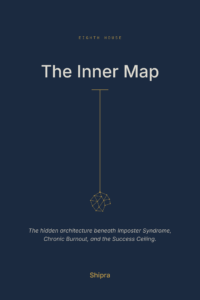
The Inner Map lists a hundred of the things people say when this is running. Most readers find several they had never once connected to exhaustion. It’s free, and it’s here.
Where a rule like that comes from
Not from your job. The job is where it became expensive.
Somewhere early, long before you had any say in it, your system wrote a rule about what keeps you safe. Behind this particular pattern, it usually reads something like: I’m only safe while I’m producing. Or: rest has to be earned.
The objection arrives immediately and is almost always sincere, but I had a good childhood. That’s generally true, and it doesn’t change anything. Rules like this don’t require something bad to happen. They require something ordinary, repeated, to a brain that cannot yet interpret context.
A child cannot reason that the house is tense because of a restructure. So the child brain does the only thing available, watches what happens, and draws a conclusion about itself.
It’s the same machinery that gave you your accent. Absorbed, never taught, unnameable, and completely fluent.
And here’s the thing about that rule: back then, it wasn’t wrong. It probably kept you loved. Nobody ever went back and updated it.
One question
When did you last rest without an excuse?
Not ill. Not travelling. Not recovering. Nobody cancelled. You decided to stop, and you stopped.
Notice how long you are searching.
If you’re scrolling back through years, that search is the answer. And the illness on day two of the holiday was your body finding the only route to rest that your own rule permits.
Common questions
A term coined by Dutch psychologists in 2001 for the pattern of being rarely ill during the working week and becoming ill on weekends or holidays. Reported symptoms include headache and migraine, fatigue, muscle pain, nausea, and viral infections. It is a researched phenomenon, not a recognised medical diagnosis.
How common is it?
In the original Dutch survey, around 3% of nearly 1,900 people recognised themselves in the description. The research base since has stayed small, so treat the figure as an indication rather than a settled prevalence.
Why do I get a migraine every weekend?
Weekend migraine is one of the most frequently reported forms of this pattern. The leading explanation involves the abrupt drop in stress hormones when sustained pressure lifts, though the evidence base remains limited.
Who is most likely to experience it?
The original research found the sharpest differences in experienced workload, sense of responsibility toward work, and difficulty relaxing, rather than in lifestyle or how people spent their time off.
How do I stop getting sick on holiday?
Most advice targets the transition, winding down before you stop rather than sprinting to the last hour. That can help. But if the pattern has run for years, the more useful question is not how to manage the transition. It is why your system only permits rest when the stopping isn’t your choice.
My gift to you!
The Inner Map
A short book about the rule underneath, where it took root, and what it has been deciding for you across every layer of your mind and every domain of your life.
It includes a hundred of the things people actually say when this is happening to them. Most readers recognise several they had never connected to any of this.
